
First, what is a “junk rep”?
People use the term loosely. We mean a repetition that adds fatigue without adding much useful stimulus or practice. Maybe the load is too light and you are nowhere near a challenging set. Maybe the range has shortened, the target muscles have stopped doing the work and momentum has taken over. Maybe you are continuing only because a number on a programme told you to.
Not every imperfect rep is junk. Technique changes a little when effort rises. The question is whether the rep still serves the goal. Can you control it? Is the intended pattern still there? Is the effort coming from the places we want to train?
01 · 3 sets · 6 to 10 reps
Landmine deadlift
This is our hinge. It trains the glutes, hamstrings, back, grip and the skill of producing force through the floor. The landmine keeps the load close and gives many people an approachable route into heavier lifting.
Progress it: add a rep, pause just off the floor, use a slower controlled lowering phase or increase the range from a safe platform before adding load.
02 · 3 sets · 8 to 12 reps each side
Rear-foot elevated split squat
A single-leg squat pattern asks the hips, knees, ankles and trunk to organise force together. It also lets each side work honestly. Hold support when you need it. Balance should not prevent the legs from receiving a useful training stimulus.
Progress it: use less hand support, increase comfortable depth, add a pause near the bottom or keep the same load and complete more clean reps.
03 · 3 sets · 8 to 15 reps
Seated cable row
The row trains the upper back, arms and trunk. Keep the ribcage organised, reach without collapsing and pull without turning the finish into a whole-body heave.
Progress it: lengthen the reach, pause with the handle close, slow the return or move from bilateral to alternating reps.
04 · 3 sets · 6 to 12 reps
Z-press
Sit tall with the legs long or comfortably apart and press overhead. With less help from the lower body, the shoulders and trunk have to negotiate the task together. Elevate the hips or choose another press if mobility limits the position.
Progress it: improve the stacked finish, add a rep, pause overhead or alternate arms. Do not trade spinal control for a heavier dumbbell.
05 · 3 sets · 8 to 12 reps each side
Dumbbell step-up
Step-ups train the legs and hips while asking you to transfer force onto one leg, control the pelvis and own the way back down. Choose a step height that lets the working leg do the work.
Progress it: reduce the push from the trailing foot, slow the descent, increase the step slightly or carry the dumbbell on one side to add a trunk challenge.
How to use the five moves
Warm up, then complete the movements in order or alternate lower- and upper-body exercises. Rest long enough to make the next set useful, usually 60 to 150 seconds depending on load and experience. More rest is not cheating. It is often what lets quality stay high.
If all prescribed sets reach the top of the rep range with clean technique and two or more reps still in reserve, progress one variable next time. Load is one option. It is not the only one.
Research on hypertrophy supports a wide range of repetition durations, though extremely slow repetitions may be less effective.[3] Use tempo to create control, not to turn a straightforward exercise into choreography.
A full-body programme does not need to exhaust every possible movement. It needs to cover the important patterns, progress them and leave you able to return.
Where coaching changes the experience
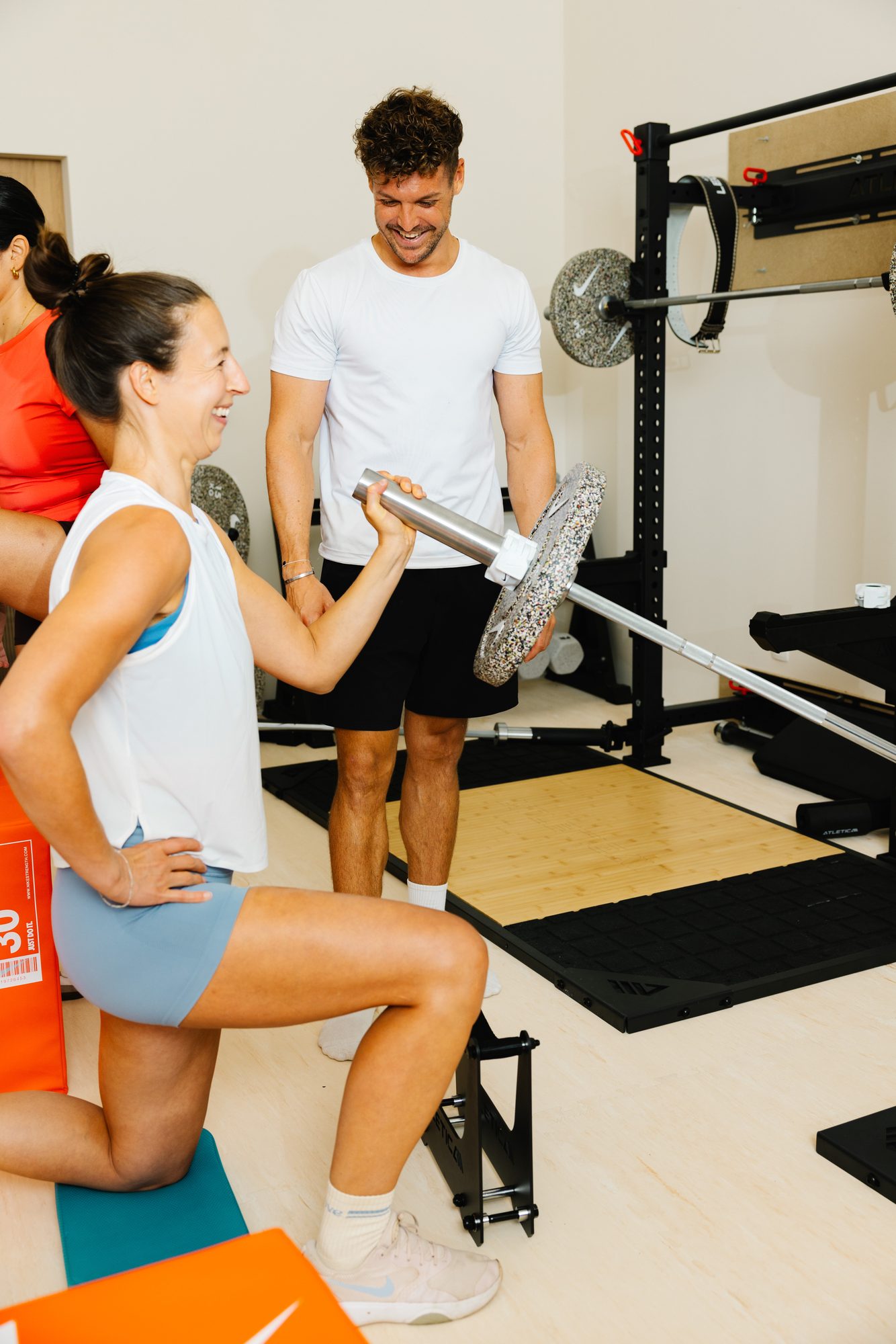
A list cannot see your body. It cannot adjust a stance, choose a more useful range or tell the difference between effort and pain. That is why our Strength Lab is coached in small groups. You still do the work. You simply do not have to guess at all of it.
These movements are drawn from our two Strength Lab training blocks. Short demonstration clips will be added when the final videos are available.
Sources and further reading
- Effects of resistance training performed to failure or non-failure
- Low-load versus high-load resistance training for strength and hypertrophy
- Repetition duration and muscle hypertrophy
This article is educational and does not replace individual medical or nutrition advice. Research changes, and personal health history matters.